Novo Nordisk’s investigational zenagamtide shows significant A1C reductions with up to 14.6% weight loss in adults with type 2 diabetes–presented at ADA 2026
A phase 2 study of investigational once-weekly subcutaneous zenagamtide showed statistically significant reductions in blood sugar in adults with type 2 diabetes compared to placebo, with up to 89.1% achieving A1C below 7%1
Additionally, participants treated with zenagamtide showed body weight loss up to 14.6% at week 36 with the highest dose investigated, 40 mg1
Zenagamtide will advance into phase 3 clinical trials in adults with type 2 diabetes based on these results
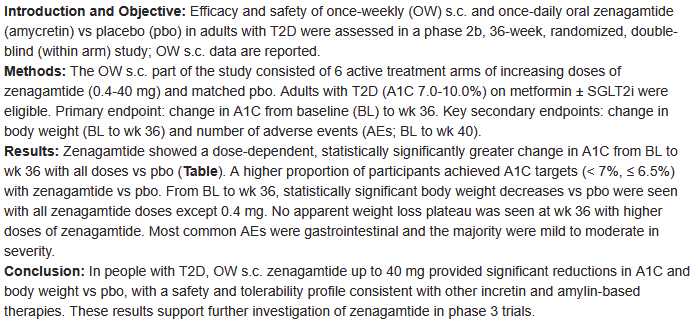
PLAINSBORO, N.J. and BAGSVÆRD, Denmark, June 5, 2026 /PRNewswire/ – Novo Nordisk today announced new clinical data from the positive phase 2 trial of investigational zenagamtide, also known as amycretin. Zenagamtide is the first of its class, being a unimolecular peptide agonist of GLP-1 and amylin receptors.1 Presented at the 2026 Scientific Sessions of the American Diabetes Association® (ADA) in New Orleans, LA, results from the phase 2 dose finding study included the evaluation of six subcutaneous doses of zenagamtide (ranging from 0.4 mg to 40 mg) versus matched placebo in 262 adults with type 2 diabetes inadequately controlled (A1C 7.0–10.0%) on metformin, with or without an SGLT2 inhibitor. The study met its primary endpoint of change in A1C across all doses and also key supportive secondary endpoint of change in body weight (with doses 1.5 mg and greater) with zenagamtide versus placebo after 36 weeks.1
“Zenagamtide is the first investigational treatment for type 2 diabetes to combine GLP-1 and amylin receptor agonist mechanisms of action in a single molecule. These phase 2 results build on the growing body of evidence which demonstrates the potential of zenagamtide to meaningfully impact blood glucose control in patients with type 2 diabetes and also body weight,” said Martin Holst Lange, chief scientific officer and executive vice president, Research & Development at Novo Nordisk. “These results underscore our scientific leadership and position us to continue advancing innovative treatment options that could expand the therapeutic landscape and provide patients and healthcare professionals with greater choice in managing type 2 diabetes.”
The phase 2 study showed a dose-dependent and statistically significant change in A1C from baseline to week 36 with all doses vs placebo. From a baseline of 7.8%, the estimated mean change in A1C at week 36 was up to ‒1.71% with zenagamtide 40 mg (estimated treatment difference [ETD] vs placebo: ‒1.56% [95% confidence interval (CI): ‒2.05, ‒1.07]; p<0.0001).1 Up to 89.1% of participants on zenagamtide achieved A1C levels below 7%, and up to 76.2% achieved levels at or below 6.5%.1 Notably, the proportion of time spent within target range of 70–180 mg/dL (3.9–10.0 mmol/L) was above the internationally recommended target of >70% across all zenagamtide doses investigated (up to 91.5% with zenagamtide 40 mg).1 These results suggest strong glycemic efficacy, considering that the higher zenagamtide dose treatment groups were only exposed to the maintenance dose for a short period of time (ie 20 mg for 8 weeks and 40 mg for 4 weeks).1
As a key supportive secondary endpoint, trial participants taking zenagamtide also saw a mean body weight reduction of up to 14.6% (baseline body weight ~219 lbs) with the 40 mg dose compared with 2.1% with placebo.1 No apparent weight loss plateau was seen at week 36 with the higher doses of zenagamtide.1
Table. Endpoints: once-weekly subcutaneous zenagamtide vs placebo
Once-weekly subcutaneous zenagamtide
Participant (N=262) baseline characteristics: Male 66%; mean age 57.1 yrs; A1C 7.8%; body weight 99.2 kg (218.7 lbs); 40% on SGLT2i.
All patients on a stable dose of metformin with or without SGLT2 inhibitor.
Each endpoint was analyzed using an ANCOVA model. The analyses were based on data from the on-treatment without rescue medication observation period.
Using the dose–response model for analysis, the estimated mean change in A1C from baseline to week 36 was up to –1.8% (ETD vs placebo [95% CI]: –1.58 [–2.08, –1.08]; p<0·0001); the estimated mean change in body weight was up to –14.5% (ETD vs placebo [95% CI]: –11.81 [–15.37, –8.25]; p<0.0001), with zenagamtide 40 mg.
This trial used a fixed-dose-escalation trial design; if the planned treatment dose was not tolerated, treatment was permanently discontinued.
In the trial, the most common adverse events were gastrointestinal, and the majority were mild to moderate in severity. The safety and tolerability profile in this phase 2b trial was consistent with other incretin and amylin-based therapies. These results support further investigation of zenagamtide in phase 3 trials.1
Based on the results, Novo Nordisk is planning to initiate a phase 3 development program with zenagamtide for adults with type 2 diabetes in H2 2026.
.