Et utdrag fra en meget god artikkel:
https://seekingalpha.com/article/4349252-u-s-savings-problem-fed-cant-fix
First we need to define the terms…
Saving: All production that is not consumed.
Investment: All goods produced for the purpose of producing other goods and services.
Depreciation: The wear and tear of investment goods over time.
All Investment Must First Come From Savings
The best way to understand savings in the economic sense is to consider that all goods that are produced are either produced for consumption (consumer goods) or to be used in the production of other goods (investment goods). This means that all the goods that are produced and not consumed now are used for investment. It should be clear therefore that all investment must come from savings.

Source: Bloomberg, Federal Reserve
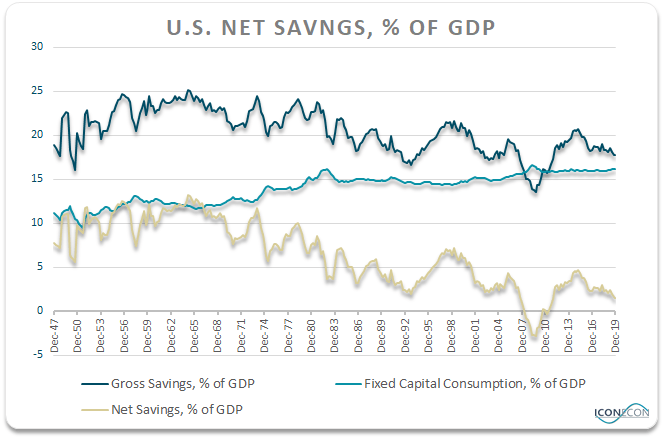
In 2019 the U.S. economy produced just under USD22trn worth of goods and services at current price levels. However, total consumption of goods and services amounted to just under USD18trn while consumption of fixed capital (depreciation) amounted to roughly USD3.5trn. This means that total savings in the economy amounted to just USD340bn, or 1.5% of GDP.
The decline in the U.S.’ national savings rate reflects a number of policy decisions and cultural dynamics, but perhaps the two most important have been the rise in government transfer payments and the decline in real interest rates. Both of these policies have undermined the desire of individuals to save.
Saving Is Not A Drag On Growth
If all investment comes from savings then it should be clear that higher savings levels are positive for economic growth. The more savings available in an economy, the greater the potential for businesses to find profitable opportunities for any given amount of labor. The more infrastructure, factories, machinery and equipment etc. that exist, the more productive labor will become.
This idea seems to be lost on the financial media and mainstream economists which see saving as some kind of a drag on growth; a leakage from the economic system. The misunderstanding likely comes from the fact that the majority of final sales in an economy are on consumer goods and services and so any increase in household savings rates can hurt consumption. In the near term, consumption and investment are often substitutes: in order to invest more we have to consume less. However, in the long term they are compliments: the more we invest, the more we ultimately are able to consume as productive capacity increases.
Even in the short term, an increase in consumer savings rates do not necessarily imply a slump in growth. If consumers in an economy decide to save more, this gradually frees up resources to be used to produce investment goods. Profitability in the consumer-focused industries will be reduced, but profitability in investment focused industries will concomitantly increase. Unless the rise in the savings rate is particularly sharp due to some economic shock, growth need not be negatively impacted, even in the short term. What is lost in terms of consumer goods production is made up for in terms of investment goods production.
Dette samsvarer meget godt med bekymringen som Stephan Roach har omkring manglende sparingsrate ( langt under 0 i 2020), gjeld, underskudd i US og sannsynlig dollar crash.