
AUA 2026: new studies demonstrated Blue Light Cystoscopy benefits in high-risk NMIBC management and cost comparison study
World Reproductive Health Day: World’s First Non-Invasive Portable Cervical Photodynamic Therapy Technology Launched Across 26 Cities in China, Offering a Fertility-Preserving Treatment Option for Patients with Cervical Precancer
June 9 marked World Reproductive Health Day, an initiative aimed at raising awareness of women’s reproductive health and safeguarding women’s rights to safe and satisfying sexual lives, informed reproductive choices, and safe pregnancy and childbirth.
On this occasion, the world’s first approved non-surgical, non-invasive treatment for cervical intraepithelial neoplasia grade 2 (CIN2) has been introduced in 42 hospitals across 26 cities in China, including Beijing, Shanghai, Guangzhou, Wuhan, and Shenzhen. Participating institutions include the Obstetrics and Gynecology Hospital of Fudan University, Peking University People’s Hospital, Peking University First Hospital, Renji Hospital affiliated with Shanghai Jiao Tong University School of Medicine, and Shenzhen Maternity & Child Healthcare Hospital. This milestone enables women diagnosed with CIN2—particularly younger patients who wish to preserve their fertility—to access an innovative treatment option without undergoing surgery.
From Approval to Nationwide Availability: Expanding Patient Access to Innovation
10 Days, 70 Hospitals in 30 Cities Across China: World’s First Non-Invasive, Portable Cervical Photodynamic Therapy Fully Rolled Out, Exclusively Launched on JD Health
(Shanghai, China, June 15, 2026) – Just 10 days after the first shipment of the world’s first approved non-surgical, non-invasive treatment for Cervical Intraepithelial Neoplasia Grade 2 (CIN2) departed on June 5, the innovative therapy has been deployed in 70 hospitals across 30 cities nationwide and exclusively launched on JD Health. This allows CIN2 patients to access the innovative “no surgery, fertility-preserving” treatment locally without long-distance travel.
A Race Against Time: From First Shipment to Nationwide Expansion in 10 Days
Only three months after receiving regulatory approval, and just 10 days after the first shipment, the portable cervical photodynamic therapy system has demonstrated remarkable speed in reaching patients. Key milestones over the past 10 days include:
• June 5: The first batch of products cleared customs at Beijing port and was officially dispatched to hospitals and pharmacies nationwide; the world’s first prescription was issued in Beijing on the same day.
• June 10: Patients in the first 26 cities could receive treatment at local hospitals.
• June 15: Coverage expanded to 30 cities and went live on JD Health, extending from provincial capitals and first-tier cities to regional areas.
“I heard that non-invasive technology was available in Beijing and Shanghai. I never imagined that just 10 days later, our local hospital could also offer non-invasive treatment,” said a patient who just completed treatment in Guangxi. “No hospitalization needed – you just have the device placed and go home. So convenient!”
A Non-Invasive Revolution That Preserves Fertility: Moving Beyond ‘One-Size-Fits-All Surgery’
In recent years, China has been actively promoting a fertility-friendly society. Domestic and international guidelines have shifted from “preferring excisional treatment” to “treatment strategies focusing on fertility protection.” The 2026 edition of the Chinese Expert Consensus on CIN2 Management explicitly states that for CIN2 patients of childbearing age, immediate invasive treatment should be avoided whenever possible. The ideal treatment must simultaneously achieve effective lesion clearance, preserve fertility, and be “non-surgical.”
Professor Zhao Shaojie of Wuxi Maternal and Child Health Hospital, noted: “The core of CIN2 management is not a one-size-fits-all surgery, but precise risk stratification – promptly identifying and treating patients who truly need surgery, while properly managing those who can safely preserve fertility. This way, treating the virus and the lesion while preserving fertility is no longer an either-or choice.”
Professor Li Qiling of Xi’an Jiaotong University, further urged: “In clinical practice, some young patients with precancerous cervical lesions who desire fertility have seen their reproductive capacity affected by early cone biopsy procedures. We must not only control cervical cancer at the precancerous stage but also practice precise prevention and control. By leveraging precise diagnosis, precise screening, and whole-process management of cervical cancer, and actively applying new non-invasive technologies, we can reduce invasive treatments and protect patients’ fertility.”
As a portable photodynamic therapy system combining a drug and a device, the product is placed by a gynecologist in an outpatient setting. A single treatment session takes less than 10 minutes, allowing patients to “treat and go” – no hospitalization, no anesthesia. Compared with traditional LEEP or cold knife conization, it does not damage the basal cell layer of the cervix and fully preserves cervical structure and fertility。
Cervical Care Clinics Accelerate Rollout, Benefiting More Patients in Grassroots Communities
As the portable cervical photodynamic technology rapidly expands to more cities, an increasing number of hospitals are proactively incorporating non-invasive treatment into their standard clinical pathways for cervical precancerous lesions. Many have established or upgraded “Cervical Care Demonstration Clinics” to provide comprehensive services from screening and diagnosis to treatment and follow-up.
Professor Xiong Chunqiu of the Guangxi Zhuang Autonomous Region Maternal and Child Health Hospital, stated: “In the past, there was often no intermediate option between ‘watchful waiting’ and ‘surgical excision.’ When patients are anxious about ‘watchful waiting,’ surgery becomes the default choice. Non-invasive technology fills this clinical gap, aligning with the national policy of building fertility-friendly hospitals – protecting fertility from the source.”
Professor Chen Yan of the First Affiliated Hospital of Anhui Medical University, commented: “The portable photodynamic non-invasive technology has taken non-surgical treatment for CIN2 to a new level, making the stepwise pathway of observation → non-invasive → surgery smoother. Building fertility-friendly hospitals is not just a slogan; it’s about helping more young women preserve their hope of fertility while effectively treating their disease.”
It is learned that the accessibility of portable cervical photodynamic technology continues to expand, with coverage expected to reach hundreds of hospitals in over 50 cities nationwide within the year. Meanwhile, a multi-center real-world study has been launched simultaneously, which will provide more Chinese data to optimize treatment standards and inform future guideline updates.
Building a fertility-friendly society requires both technological innovation and accessibility. From the June 5 dispatch to deployment in 30 cities by June 15, and the exclusive online launch on JD Health, this portable cervical photodynamic technology has turned the concept of “treating disease while preserving fertility” into a reality for more patients – all in just 10 days.
Hvis detta tempoet fortsetter tror jeg mange fortsatt undervurderer hvor fort et nytt behandlingsalternativ faktisk kan få fotfeste når leger, sykehus, distributører og myndigheter drar i samme retning.
Har man mulighet til å få ut detaljerte tall for stemmegiving?
Ja se vedlegg til børsmeldingen
Noen som kort kan oppsummere? Slå slipper jeg og 10000 andre aksjonærer å bruke tid. 
De to aksjonærforslagene fikk ca 8% og 13%:
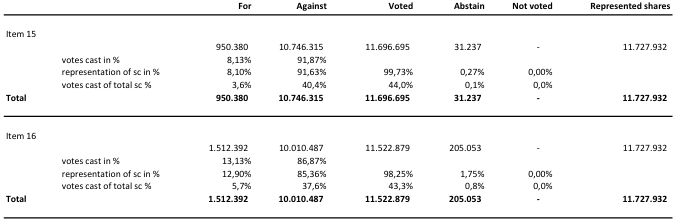
Ikke verst!
Asieris +11.64%)
Information on drugs submitted for preliminary review in accordance with the 2026 National Basic Medical Insurance, Maternity Insurance, and Work Injury Insurance Drug Catalog and the Commercial Insurance Innovative Drug Catalog Adjustment.
Cevira:
Hexvix: